Department of Water Resources Home

Salton Sea Ecosystem Restoration Program

Department of Water Resources
FloodSAFE Environmental Stewardship and
Statewide Resources Office
1416 9th Street, Room 1148
Sacramento, CA 95814

Mailing Address:
P.O. Box 942836
Sacramento, CA 94236-0001

Phone Number:
916-653-8629

Contact Us

Salton Sea logo

In the Spotlight

Secretary for Natural Resources, John Laird, has announced the release of the draft Salton Sea Species Conservation Habitat (SCH) Project Environmental Impact Statement/Environmental Impact Report (EIS/EIR). The release of the study, which was prepared jointly with the United States Army Corps of Engineers, opens a 60-day public comment period on the SCH Project, including alternative methods of restoring habitat at the Salton Sea and their impacts.

"The release of this study is an important step in a phased approach to ecosystem restoration in the Salton Sea," said Secretary for Natural Resources, John Laird. "This early start habitat will help maintain necessary habitat for the wildlife in the Salton Sea and will complement future restoration efforts."

The Salton Sea is located along one of the most important flyways in North America, providing critical habitat for more than 400 species of resident and migrating birds. As water elevation in the Salton Sea continues to decline and salinity continues to increase, the result is a decline in the habitat the birds and fish depend on and an eventual collapse of the fishery. The SCH Project will provide a range of aquatic habitats that will support fish and wildlife species dependent on the Salton Sea.

The public is invited to comment on the SCH project. The DEIS/EIR and electronic comment form can be accessed from the left margin of this webpage.

In an effort to restore the largest inland surface water body in California which supports one of the most diverse bird populations in the United States, DWR and the California Department of Fish and Game are pleased to announce the release of the draft of the Salton Sea Financial Assistance Program Guidelines and Application Package. The public has until January 23, 2012 to review and comment on the Financial Assistance Program Guidelines.

Objective

State legislation enacted in 2003 and 2004 (SB 277, SB 317, SB 654 and SB 1214) requires the Natural Resources Agency, in coordination with the Department of Water Resources and Department of Fish and Game, to undertake a restoration study to determine a preferred alternative for restoration of the Salton Sea ecosystem and the protection of wildlife dependent on that ecosystem. The objectives of the restoration are to 1) restore long-term stable aquatic and shoreline habitat for the historic levels and diversity of fish and wildlife that depend on the Salton Sea, 2) eliminate air quality impacts from restoration projects, and 3) protect water quality. The Salton Sea Ecosystem Restoration Program is coordinating efforts between the Legislature, various federal, State, and local agencies, stakeholders, and the general public to implement restoration activities at the Salton Sea in conformance with these objectives.

Information About

  • Legislation

      SB 1256: Salton Sea Restoration Council (2007-2008 Session) -- This Senate Bill would have created the Salton Sea Restoration Council within the Resources Agency (comprised of an Executive Committee, Science Committee, Local Government forum and a stakeholder forum), as the governing structure responsible for project implementation of the Preferred Restoration Plan. The hearing was on May 12, 2008 and was not approved by the Senate Appropriations Committee.

      On January 24, 2008, the Legislative Analyst's Office released the report Restoring the Salton Sea. The report discusses the history and current state of the Sea and legal and policy reasons for restoring the Sea. The report also makes recommendations on how the Legislature should proceed with the restoration.

      SB 51: Ducheny. Salton Sea Restoration Council. September 2010. This Senate Bill creates the Salton Sea Restoration Council within the Resources Agency (comprised of an Executive Committee, Science Committee, Local Government forum and a stakeholder forum), as the governing structure responsible for determining a preferred alternative for the restoration of the Salton Sea ecoystem and the protection of wildlife dependent on that ecosystem.

  • Monitoring Plans

      The Programmatic Environmental Impact Report for restoration of the Salton Sea identified the need for additional environmental data. The Departments of Water Resources and Fish and Game, in coordination with the U. S. Geological Survey, are developing long-term monitoring plans for air quality, biological resources, and hydrologic resources (including streamflow, groundwater level, and water quality). Focused Technical Groups have been formed to provide input into monitoring plan development. Completion of the monitoring plans is expected by the end of 2008.

  • Species Conservation Habitat Project

      IMPLEMENTATION PLAN FOR
      SPECIES CONSERVATION HABITAT PROJECT

      Executive Summary

      The Salton Sea provides important fish and wildlife habitat, but increasing salinity is resulting in habitat degradation. Salinity is expected to increase in future years as reduced inflows and evaporation cause the sea level to decline. The increasing salinity will eventually result in the loss of habitat at the Salton Sea and the dependent fish and bird species.

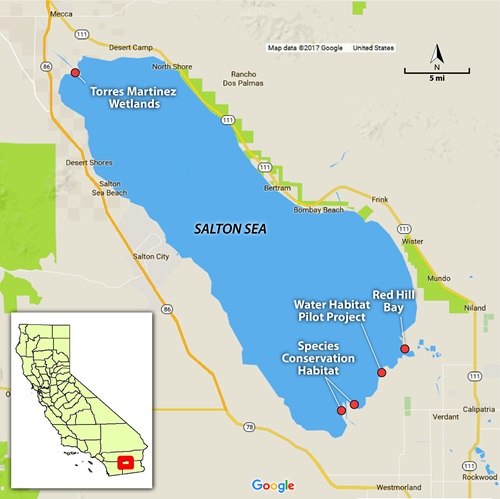
      Ponds encompassing about 100 acres have been constructed as a pilot project near the southern shoreline of the sea to evaluate the feasibility of developing shallow saline habitat to compensate for habitat that is becoming lost at the Salton Sea. Though demonstrating the feasibility of creating shallow saline habitat, the ponds were not designed to evaluate all of the issues facing development of this type of habitat. In addition, freshwater ponds continue to be successfully developed along the northern shoreline, but these do not provide the saline type of habitat that will be lost at the Salton Sea. Additional shallow saline pond development is required to evaluate issues associated with development of larger complexes of shallow saline habitat on the exposed sea bed and to begin to offset some of the anticipated habitat losses that will soon occur at the Salton Sea.

      The California Department of Fish and Game and Department of Water Resources are expanding upon the current efforts of creating shallow saline ponds to compensate for some of the habitat lost as the Salton Sea becomes increasingly saline. The implementation of conservation measures necessary to protect the fish and wildlife species dependent on the Salton Sea is being undertaken pursuant to Section 2932 of the California Fish and Game Code. The conservation measures will consist of a series of shallow saline ponds ranging from 100 to 500 acres in size and constructed on exposed playa as the sea recedes. The Species Conservation Habitat (SCH) ponds will be formed by constructing dikes using material excavated from the sea bed. Salinity will vary from 20 parts per thousand (ppt) in the initial ponds to 60 ppt in subsequent ponds. The ponds will range from four to six feet in depth, depending on the slope of the sea bed and extent of sea level decline. In addition to the open water and shoreline areas of the ponds, habitat diversity will be created by excavation of deeper areas, formation of islands, placement of artificial snags, and varying the bottom substrate to include gravel and rock to support a variety of fish and invertebrate species and provide foraging, nesting, loafing, and roosting opportunities for birds. Considering the success of the Experimental Ponds and freshwater ponds, the design and habitat features of SCH are expected to result in equal or greater success in providing habitat for invertebrates, fish, and birds to compensate for that lost as the Salton Sea becomes increasingly saline.

      A reconnaissance investigation will be completed in 2008 that identifies alternative sites for SCH and potential component designs. The reconnaissance report will evaluate the existing conditions of playa expected to become exposed, water supply characteristics and requirements, and land ownership and availability. Subsequently, preliminary design investigations to be completed in 2009 will focus on the alternative sites to refine site information, develop detailed designs and cost estimates, and initiate negotiations for land access. During this phase, environmental studies will be conducted for an environmental impact report which identifies the preferred site for SCH. Lastly, final design work will be completed by mid-2010 at the selected site, including preparation of project level plans and specifications to be used for construction bidding. During this phase, all permits will be acquired, a mitigation and monitoring plan will be developed, and steps will be undertaken to acquire legal access to land.

      SCH will initially be developed and monitored over a period of five years to evaluate the ability of the ponds to provide habitat for species dependent on the Salton Sea. The ponds will be constructed in annual phases as the sea recedes. About 800 acres of sea bed are anticipated to become exposed each year that would allow construction of about 2,400 acres of SCH over a three year period beginning in 2010. Ponds will be constructed in the first three years, with monitoring commencing following the first year of pond construction and continuing for two years after completion of pond construction. Biological and water quality parameters, habitat values and functions, and engineering performance will be monitored. Information developed from the evaluation of monitoring data will be used to refine engineering designs and wildlife management criteria, and develop adaptive strategies for continued development of SCH. Creation of additional SCH in future years using information derived from this project is dependent on the availability of fiscal resources.

      A management process has been developed to manage the development and implementation of SCH. A decision process, establishment of a Technical Advisory Group, and stakeholder and public outreach are included in the management process.

  • Background

      The Salton Sea is located in a closed desert basin in Riverside and Imperial Counties in southern California, south of Indio and north of El Centro. The basin is more than 200 feet below sea level and has no natural outlet. Although lakes have existed in this basin in the past, the current body of water formed in 1905 when a levee break along the Colorado River caused its flows to enter the basin for about 18 months. Since 1905, the Sea has fluctuated in size with varying inflow, and it today has a surface area of about 365 square miles.

      A balance between inflowing water and evaporation sustains the Sea. With no outlet, any salts that are dissolved in the inflow are trapped. Salt concentrations in the Sea are currently about 48,000 milligrams per liter (mg/L), or about 30 percent higher than ocean water. Salinity will continue to rise under current conditions, however, under the recently approved Quantification Settlement Agreement inflow to the Sea will be will be significantly reduced. The reduction in inflow will cause the Sea to shrink and cause salinity to rise faster than it would have without a reduction in inflow.

      A gradual increase in salinity and its consequences was recognized soon after the Sea was formed. Various salinity control measures were studied as early as the mid-1950s. Since then, many alternatives have been proposed and analyzed. The current effort by the California Resources Agency is the latest attempt to develop a permanent solution to continued degradation of the environmental values of the Sea.